Day 28: Chord Progressions and Melody
Wednesday, April 29th, 2026
Objectives
- I can explain what binary (AB) form is and identify the A and B sections in a short piece.
- I can use a chord progression from Hooktheory as the harmonic foundation for a melody.
- I can compose an 8-measure A section in C major and an 8-measure B section in A minor.
- I can write a simple melody over a chord progression.
Warmup — Binary Form Review
Yesterday you added a bass line to a binary-form melody. Before we move on, let’s make sure the idea sticks.
Quick review questions — answer these in your head or on a sticky note:
- How many sections does binary (AB) form have?
- What makes the B section different from the A section?
- Why does the B section often end on a note that feels “unfinished”?
After a minute on your own, Mr. Willingham will call on a few people to share their answers.
Work Session
Key Vocabulary
- Chord
- Three or more notes played together. In music, chords give the melody a harmonic “home” — they tell you what key you’re in and create a sense of movement or rest.
- Chord progression
- A sequence of chords that repeats throughout a section of music. Most pop songs use a short progression (4 chords) that loops over and over.
- Root note
- The lowest note of a chord, and the note the chord is named after. The root of a C major chord is C; the root of an A minor chord is A.
- Roman numeral analysis
- A way of labeling chords by their position in a scale. I (one) is the home chord. IV (four) and V (five) create motion. vi (six, lowercase = minor chord) adds color. This system works in any key.
Hooktheory: Real Pop Songs, Real Chords
Hooktheory TheoryTab is a searchable database of over 70,000 pop songs analyzed by their chord progressions. Every song shows the chords in Roman numerals so you can see why they work — not just what they are.
Today you will use the two chord progressions provided below. Hooktheory is here to show you just how widely used these progressions are — you will find them behind dozens of songs you already know.
Your Two Chord Progressions
A Section — C major: I – V – vi – IV
This is the single most common chord progression in pop music. Hooktheory lists 487 songs that use it, including:
| Song | Artist | Section |
|---|---|---|
| “Let Her Go” | Passenger | Chorus |
| “Demons” | Imagine Dragons | Pre-chorus/Chorus |
| “Call Me Maybe” | Carly Rae Jepsen | Chorus |
| “Wagon Wheel” | Old Crow Medicine Show | Verse |
| “Don’t Let Me Down” | The Chainsmokers | Intro |
In C major, this progression uses these chords:
| Roman numeral | Chord name | Notes in the chord | Chord |
|---|---|---|---|
| I | C major | C – E – G | 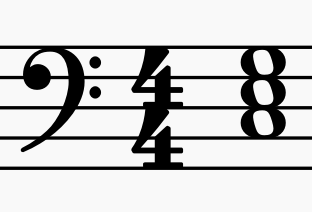 |
| V | G major | G – B – D | 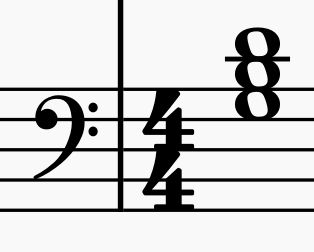 |
| vi | A minor | A – C – E | 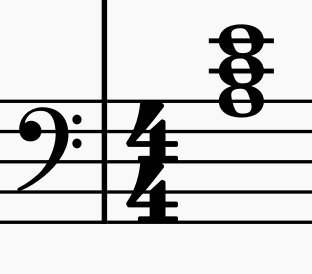 |
| IV | F major | F – A – C | 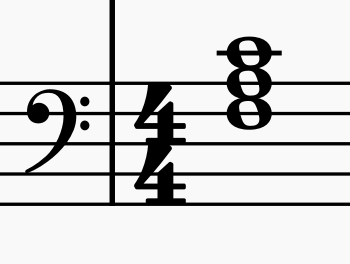 |
One chord per measure × 8 measures = play the progression twice for your A section.
B Section — A minor: i – VII – VI – VII
This progression appears in many minor-key pop and rock songs. It uses the natural minor scale (no raised 7th), giving it a darker, more dramatic feel that contrasts with the bright C major A section.
In A minor, the chords are:
| Roman numeral | Chord name | Notes in the chord | Chord |
|---|---|---|---|
| i | A minor | A – C – E | |
| VII | G major | G – B – D | |
| VI | F major | F – A – C | |
| VII | G major | G – B – D | |
One chord per measure × 8 measures = play the progression twice for your B section.
Setting Up Your MuseScore File
Open a new MuseScore file with these settings:
- Time signature: 4/4
- Key signature: C major / A minor (no sharps or flats — leave it blank)
- Measures: 16 total (8 for the A section + 8 for the B section)
- Instrument: Piano (grand staff — treble clef for melody, bass clef for chords)
Step-by-Step: Building Your Piece
Step 1 — Enter the A section chords (measures 1–8)
- Click the first measure of the bass clef staff.
- Press N to enter Note Input mode.
- For each measure, you will enter a chord. Press 7 to choose a whole note — this fills the entire measure with one chord.
- Type the root note (the letter name of the first chord note). Then hold Shift and type each additional note to stack the chord.
A section chord sequence (repeat twice, mm. 1–8):
| Measure | Chord | Root | Add (Shift + letter) |
|---|---|---|---|
| 1 | C major | C | Shift+E, Shift+G |
| 2 | G major | G | Shift+B, Shift+D |
| 3 | A minor | A | Shift+C, Shift+E |
| 4 | F major | F | Shift+A, Shift+C |
| 5 | C major | C | Shift+E, Shift+G |
| 6 | G major | G | Shift+B, Shift+D |
| 7 | A minor | A | Shift+C, Shift+E |
| 8 | F major | F | Shift+A, Shift+C |
Step 2 — Enter the B section chords (measures 9–16)
B section chord sequence (repeat twice, mm. 9–16):
| Measure | Chord | Root | Add (Shift + letter) |
|---|---|---|---|
| 9 | A minor | A | Shift+C, Shift+E |
| 10 | G major | G | Shift+B, Shift+D |
| 11 | F major | F | Shift+A, Shift+C |
| 12 | G major | G | Shift+B, Shift+D |
| 13 | A minor | A | Shift+C, Shift+E |
| 14 | G major | G | Shift+B, Shift+D |
| 15 | F major | F | Shift+A, Shift+C |
| 16 | G major | G | Shift+B, Shift+D |
Step 3 — Play back the chords
Press Space to hear the chord progression from beginning to end. Notice:
- The A section (mm. 1–8) should feel bright and familiar — like a pop chorus.
- The B section (mm. 9–16) should feel darker and more tense — the G chord at the end of each group never quite resolves, which keeps the music moving forward.
Make sure each chord sounds clear. Fix any notes that ended up in the wrong octave before moving on.
Step 4 — Write a melody over the A section (measures 1–8)
Switch to the treble clef staff (the top staff). Your melody goes here.
A section melody guidelines:
- Use notes from the C major scale: C D E F G A B C
- Start on C or E — both are in the first chord (C major) and will sound settled.
- End measure 8 on C to reinforce the home key before the B section begins.
- Try using mostly stepwise motion (moving up or down by one step at a time).
- Use quarter notes and half notes to start. Add eighth notes once your basic melody is working.
A simple melody idea to get started (you can change it):
| Measure | Beat 1 | Beat 2 | Beat 3 | Beat 4 |
|---|---|---|---|---|
| 1 (C) | E | E | G | G |
| 2 (G) | D | D | B | — (half note) |
| 3 (Am) | C | D | E | C |
| 4 (F) | F | E | D | C |
Repeat or vary this for measures 5–8.
Step 5 — Write a melody over the B section (measures 9–16)
Your B section melody should contrast with the A section. Try at least one of these strategies:
| Strategy | What to do |
|---|---|
| Different starting note | Begin on A — the tonic of A minor — rather than C or E. |
| Different direction | If your A section mostly moved up, have the B section mostly move down. |
| Different rhythm | If your A section used lots of quarter notes, try more half notes — or vice versa. |
| Higher or lower range | Stay above the notes you used in the A section, or below them. |
B section guidelines:
- Use notes from the A natural minor scale: A B C D E F G A
- These are the same white keys as C major — no sharps or flats needed.
- Try starting on A or E (both are in the i chord, A minor).
- End measure 16 on A to make the B section feel finished.
Step 6 — Add section labels
Use Add → Text → Staff Text to label your score:
- Write A above measure 1.
- Write B above measure 9.
- Optionally add C major above measure 1 and A minor above measure 9.
Step 7 — Listen and revise
Press Space and listen to your full 16-measure piece. Ask yourself:
- Does the melody in the A section feel like it belongs over those chords?
- Does the melody note at beat 1 of each measure relate to the chord underneath it?
- Does the B section feel different enough from the A section?
- Does the piece feel finished at measure 16?
Make at least two intentional changes before saving.
Step 8 — Save your file
Press Ctrl + S (Windows) or Cmd + S (Mac).
Checkpoint: Work Session
- I entered all 16 measures of chords in the bass clef staff (A section: I–V–vi–IV × 2; B section: i–VII–VI–VII × 2).
- I played back the chords and fixed any octave or pitch errors.
- I wrote a melody over the A section (mm. 1–8) using notes from C major.
- I wrote a melody over the B section (mm. 9–16) using notes from A minor.
- My B section melody contrasts with my A section melody in at least one way.
- I added A and B section labels to the score.
- I listened to the full piece and made at least two revisions.
- I saved my file.
Closing
Play your finished piece from start to finish one more time and think about these questions:
- Which measure sounds the best to you? What is the melody note on beat 1 of that measure, and does it come from the chord underneath it?
- Which moment sounds the most tense? What chord is underneath it? (Hint: it is probably the G major chord in the B section.)
- What is one change you would make if you had more time?
When you’re ready, submit your MuseScore file (.mscz) to the Day 28 assignment in CTLS. Make sure the file has:
- All 16 measures of chords (bass clef)
- A melody (treble clef) for both sections
- Section labels (A and B) visible in the score
Standards
- MSMTC8.CR.1 — Generate musical ideas for various purposes and contexts (using a Hooktheory chord progression as the harmonic foundation for an original melody).
- MSMTC8.CR.2 — Select and develop musical ideas for defined purposes and contexts (choosing melody notes that fit each chord in an 8-measure A section and an 8-measure B section).
- MSMTC8.CR.3 — Evaluate and refine selected musical ideas to create musical work that meets appropriate criteria (listening back and making at least two intentional revisions before submitting).
- MSMTC8.CR.4 — Share creative musical work that conveys intent, demonstrates craftsmanship, and exhibits originality (submitting a finished 16-measure composition with chords and melody to the Day 28 assignment in CTLS).